The Battle of Bagradas (255 BCE) — fought between the consul Marcus Atilius Regulus and the Spartan mercenary general Xanthippus — takes place on the Great Plains of Tunisia. After landing in Africa, the Romans marched toward the city of Carthage. With previous commanders proving incompetent, Xanthippus assumed command of a demoralized Carthaginian army, reformed it, and marched out to face the Roman advance. Historically, Xanthippus routed the Roman army, captured Regulus, and restored Carthage as a major and formidable power in the Mediterranean.

Everything is neat and tidy at the start of a big battle! Alastair briefs the players before the game begins. It's his very first time hosting a tabletop game at a convention. He feels nervous kicking it off but eventually settles into gameplay.

The Romans deployed their velites as a screening force to protect the infantry from oncoming missile fire. The few Roman cavalry that survived the voyage over the Mediterranean were placed on the flanks to support the infantry advance. And finally, the heavy infantry, formed in maniples, were placed in a checkerboard pattern to allow skirmishers and exhausted soldiers to move to the back lines. Fresh reserves wait behind.

The Carthaginian army was very diverse. Soldiers from Morocco to Greece fought as one cohesive force. The Liby-Phoenician heavy cavalry and the elite Numidian cavalry were placed on the flanks of the Punic army. The skilled African horsemen outnumbered the Roman cavalry 8 to 1. In front of the Carthaginian army were African and mercenary skirmishers escorting Punic war elephants. The core of the army, the phalanx, was meant to finish off the enemy after the elephants wreaked havoc.

The armies steadily advanced, while the skirmishers of both sides exchanged volleys of pila.

The Punic war elephants maneuvered to the flanks of the Carthaginian army.

The heavy infantry from both armies advanced on one another. Any skirmishers remaining were trapped between the two lines.

The Carthaginian left wing used their horsemen and elephants to destroy the inferior Roman cavalry and flank the main force.
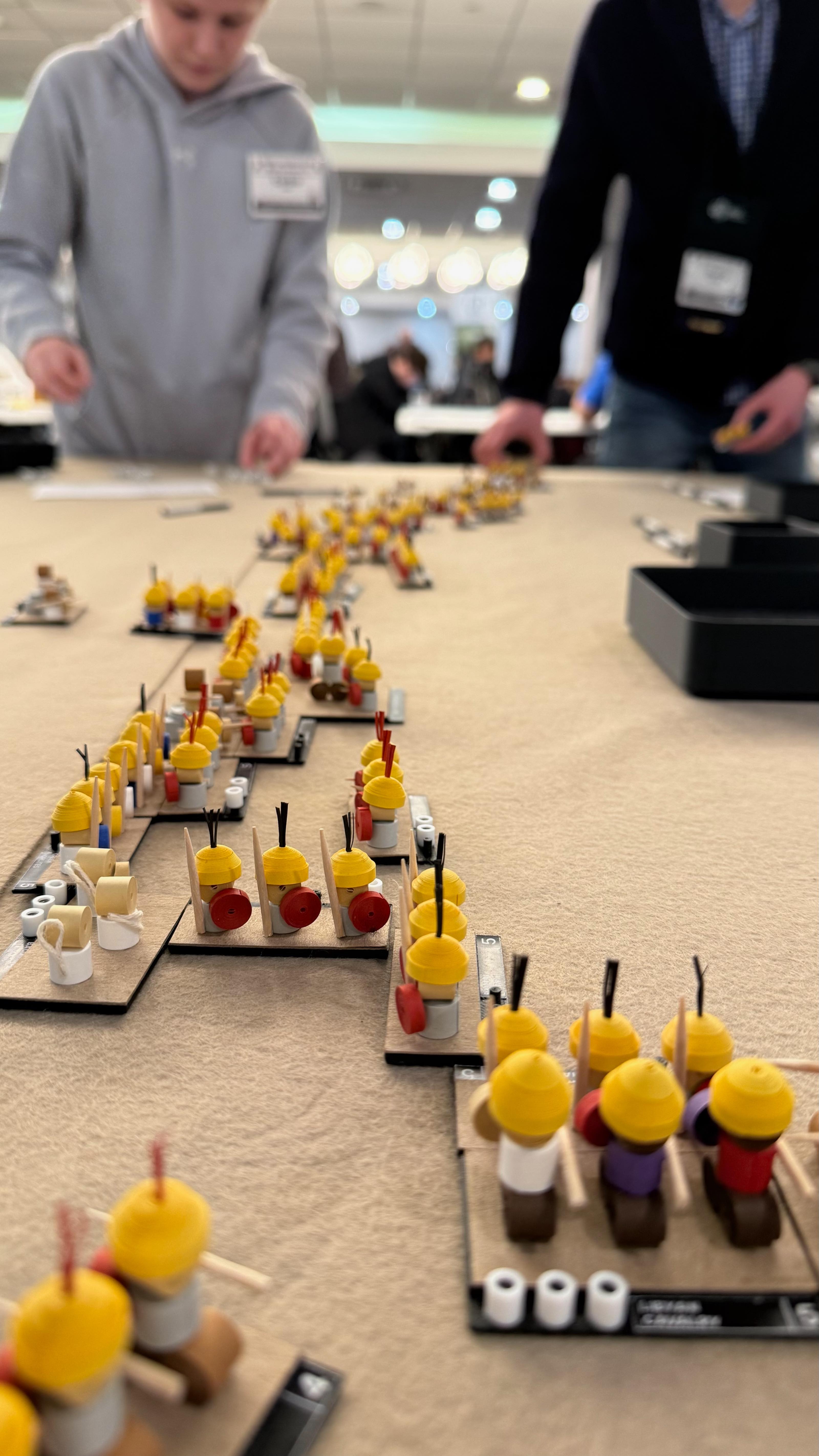
But on the other flank, in a display of brilliant command and some luck, the heavily outnumbered Roman cavalry held steadfast until infantry reinforcements could trap the Numidians.

Both armies were engaged in fierce combat, each rolling the other’s flank.

The melee devolved and the Carthaginian line was slowly waning. In a last-ditch effort…

The war elephants in reserve charged forward, breaking the Roman line!

Many less disciplined Romans were routed by the elephant charge. It was only a matter of time before the Carthaginian army completely surrounded the Roman right wing.

The Punic cavalry and elephants finished off the remaining infantry and cut down any routing units.

As the three-hour mark closed in, we declared the battle a costly Carthaginian victory. The score was 26 to 28, which is a very close game. Both armies suffered heavy casualties. The Carthaginians succeeded in expelling the Romans from North Africa, saving the city of Carthage.
The players really enjoyed the game, and the battle was very close until the end. The paper miniatures attracted a lot of attention and drew in a crowd. Their vibrant colors and abstract look could be seen upon first approach in the big ballroom. It was a fun Saturday morning.
I am excited to bring my paper miniatures to Historicon this summer! If you're interested in purchasing a bespoke set, please email us at hello@schnepfbros.com.
Schnepf Bros on YouTube
Schnepf Bros on LinkedIn
Schnepf Bros on Instagram
Schnepf Bros on Facebook