For months, the Schnepf Bros have been designing, prototyping, and fabricating a new Napoleonic game. We brought the game to HMGS Historicon 2026 to test it in three different battles: Marengo, Waterloo, and Borodino. It is Kriegsspiel-inspired, but fundamentally very different. Hosting these games with an audience of experienced gamers, we hoped to receive direct and helpful feedback.

When first designing this game, we laid out our objectives. The game should:
Game Mechanics
Objective: Capture Napoleon’s famous battles like Waterloo, Marengo, and Borodino without feeling oversized.
Formation: Portray the Napoleonic tactical formations such as line, column, and square.
Scale: Have an accurate troop scale, ground scale, and time scale that all work well with each other.
Research: Be based on credible books on Napoleonic tactics more so than other Napoleonic wargame systems.
Command: Have a realistic command and control system that balances command friction with playability.
Playability: Be easy to learn so that players who have never played a Napoleonic wargame before can handle it.
Design: Have a clean, beautiful-looking table without the clutter of markers and tokens.
Campaign: Set battles on the stage of a larger campaign.
Fog of War:Represent fog of war in an elegant manner on a single table.
Game Logistics
Maps: Be played on maps that can fit on a standard 4’ by 6’ table.
Players: Be playable by a minimum of two players and a maximum of twelve players.
Modularity: Be a modular system that allows for players to build armies and reuse pieces for different battles.
Portability: Be easily portable and storable.
Production: Be scalable for large-scale production.

On Wednesday night, we hosted the Battle of Marengo. Historically, Marengo was a near disaster for Napoleon. If it were not for his loyal general Louis Desaix, it could have spelled ruin for his army, and even his rule. But the battle is known as his greatest comeback for a reason, as he swept the Austrians from the battlefield just as the sun was setting over the horizon.

A photo of the initial setup of the battle from the Austrian point of view.

The Austrian army under Michael von Melas had crossed the Bormida River from Alessandria. They hoped to catch the French off guard and overwhelm them. The French forces looked meager compared to the Austrians.
One piece or "unit" in the game represents a battalion of infantry, a regiment of cavalry, or a battery of artillery. Small battalions are often grouped with other small battalions to form one unit, and large battalions are often broken into two units.

The Austrians began by bombarding the French across the Fontonone stream. They would not yet send their infantry across the stream, and instead looked for paths around.

The Austrians attacked where the stream was not in their way. This lone French line infantry desperately defended against the oncoming Austrians.
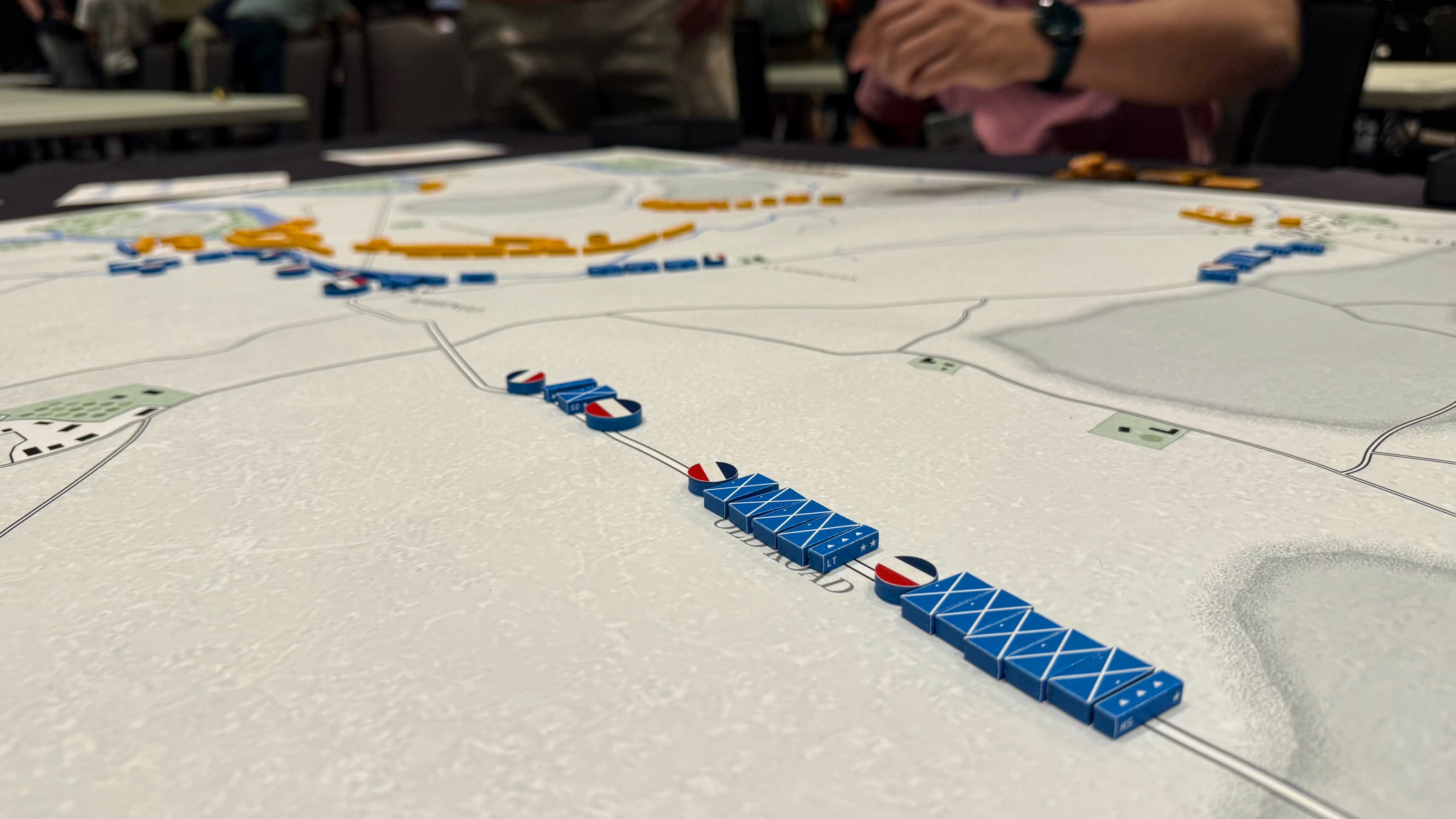
The French were hard-pressed. Lucky for them, reinforcements under Jean Lannes were on their way.

Although Alastair and I are supposed to stay neutral when helping the players, it seems he is a little biased for the tricolor cockade. Vive la France!
His hand is on a stack of books we referenced while developing the game. Most of our game rule decisions are supported by a historian’s research. Of course, a game is only a partial representation of reality, so it is in no way fully realistic to what actually happened!
We highly recommend these authors for studying Napoleonic tactics:
• The Art of Warfare in the Age of Napoleon by Gunther E. Rothenberg
• With Musket, Cannon, and Sword by Brent Nosworthy
• Tactics and the Experience of Battle in the Age of Napoleon by Rory Muir
• French Napoleonic Infantry Tactics by Paddy Griffith of Osprey Publishing
We also used a lot of George Nafziger's extensive resources online.

On the edge of the table, we keep the extra pieces for players to change to line, column, and square formation. You will notice that every unit has an accompanying number of stars on its graphics. As part of our game system, we decided to rate all units with a simplified class system. One star is low, four stars is high.

A view of the battlefield from the north.

The Austrians finally began crossing the stream. They made sure to cross cautiously. One swift counterattack could push them right back to where they started.

The Austrian cavalry charged home against a French battery. The nearby infantry formed square formation and could only watch their comrades.

Once in a favorable position, the Austrians attacked all across the line. The stream caused disorder, but the white-jackets were determined.

And just like that, two hours were up! I could tell the players wanted to play more, but it was getting late for everyone. Alastair and I were both pleased with the game. While a decisive conclusion is always satisfying, we were much more interested in getting strong feedback on game mechanics.

Our next engagement was the climactic Battle of Waterloo. Almost all experienced wargamers have played this classic battle at some point, so we decided to give it a try with our new game rules.

Alastair and I were very fortunate to have a range of generations join our table. It was helpful to receive feedback from different perspectives.

A classic scenario. Can Wellington hold off Napoleon until the Prussians arrive?
We had not finished developing a fog of war system in time for Historicon. The next Waterloo will have the British hidden from Napoleon's view behind the ridge.

The French began with a bombardment of the famous Château de Hougoumont. The infantry prepared for an attack.

The British lines waited patiently for the French to begin the attack.

Once the guns went silent, the infantry swarmed ahead. The garrison in Hougoumont consisted of a mix of British guards and allied German troops. They fought bitterly to hold their position.

The French gave up their fruitless attack on the farm and moved on to hit the British line. The French Imperial Guard (above the Hougoumont) smashed the British infantry in front of them. The French player wondered why he did not do this in the first place.

On the other side of the battlefield, the British were relieved to see the first flags of the Prussians.

Half of the Imperial Guard was sent in an emergency to secure Plancenoit before the Prussians could reach it. The French felt overwhelmed on this side of the battle and were beaten back little by little.

The battle was announced as an Anglo-Prussian victory. Although the French made some gains, their position had become untenable when the Prussians arrived.
If the French had not been so concentrated on taking the Hougoumont and Frischermont farms, they could have pushed for the ridge and pried Wellington off of it. Also, a misdeployment by the French had them scramble their entire battle line once the Prussians arrived, giving the British the breathing room they needed.
At the end, the players gave us valuable praise and critique. We were able to incorporate this feedback before the Battle of Borodino, which we were hosting the very next morning.

The third and final battle that we hosted was the epic Battle of Borodino. More than 350 pieces, representing almost 300,000 men! For perspective, that's twice the size of Waterloo, and six times Marengo. We were curious (and nervous!) to see how our game would hold up at this scale.

Borodino was the battle Napoleon was waiting for. For months, he had chased the Russian army over hundreds of miles in search of a decisive, set-piece battle. This was his chance.

The game pieces were 3D-printed with our Prusa Mini at home. Alastair would stop the print halfway through to insert a small piece of lead. This added weight and heft to the pieces. We designed the graphics for the pieces and printed them on sticker paper before applying them. Yes, this was a slow and tedious process, given that we had hundreds of pieces.
The maps were thoroughly researched and then designed by us in Figma. We sent them to a local print shop, The Country Postman, to be printed on canvas material. We are very happy with how they turned out.

Unfortunately for the French, Napoleon was sick the day of Borodino. He was present at the battlefield, but stayed in his tent for most of the day. Many believe this is the reason Napoleon made some of the decisions he did. We made sure to represent this in the command and control system of the game.

Russian jaegers defended the town of Utitza. If the French took hold of this town, they would be in a favorable position to launch an attack on the Russian flank.

In the center, the bulk of the French infantry deployed around the Shevardino redoubt. They had fought bitterly for that redoubt the day before. Napoleon set up his headquarters at Shevardino.

The Russians suffered terribly from command problems during the day. For each of the three battles, we tested out a different command and control system. With the feedback we received, we were able to decide on the smoothest one.

We intentionally made the table clear of markers and tokens that clutter gameplay. This keeps the table clean and easy to understand.

There were a total of six players who joined this game: three French and three Russian.

We are very surprised by the optimism and enthusiasm the game received at Historicon. We had multiple players come to us to preorder the game. We are not quite in that phase yet, though it was nice to have the support.
Alastair and I are still weighing out the best name for this game. Please email us at hello@schnepfbros.com to share your ideas!
We will be bringing this game to Fall-In 2026! Please let us know if you are interested, and we will keep you posted. We will play one battle, hosted over two days. Hint: Napoleon's first defeat as Emperor!
Schnepf Bros on YouTube
Schnepf Bros on LinkedIn
Schnepf Bros on Instagram
Schnepf Bros on Facebook